
Key Takeaways
- Halloween vocabulary differs across languages and reveals varied cultural views of death, fear, spirits, ancestors, religion, and celebration.
- Direct word equivalents (e.g., ghost → fantasma, fantôme, Geist, yūrei) often carry different images and folklore, so vocabulary cannot be separated from cultural context.
- Onomatopoeic spooky sounds like “Boo!” are represented differently by language (Buh!, ¡Bú!, Bouh!, etc.), and written sound effects are shaped by each linguistic system.
- Supernatural creatures and seasonal traditions (La Llorona, banshee, yōkai, Día de los Muertos, All Saints’/All Souls’ customs) vary widely; labeling all figures as “ghosts” or “monsters” can erase important cultural meaning.
- Translation and international marketing require cultural localization and often professional linguists: literal translations, puns, and images may lose meaning or cause offense without cultural adaptation.
Have you ever wondered what a ghost says in another language? Explore our new york translation services for details.
English speakers might immediately answer “Boo!” But travel beyond the English-speaking world, and the sounds, words, supernatural creatures, and customs associated with spooky celebrations can change dramatically.
Halloween words across languages reveal much more than different ways to describe ghosts, witches, costumes, and candy. They show how communities understand death, fear, spirits, ancestors, religion, and celebration.
For language learners, educators, travelers, and international marketers, these differences offer a fascinating reminder: words carry culture with them.
Halloween Words Across Languages Reveal Cultural Differences
Halloween vocabulary seems simple in English.
Words such as “ghost,” “witch,” “haunted,” “pumpkin,” “costume,” and “trick-or-treat” are instantly recognizable to many English speakers. Yet direct equivalents in another language may carry different associations.
Take the word “ghost.”
Spanish speakers may use fantasma, French speakers fantôme, German speakers Geist, and Italian speakers fantasma. Japanese offers words such as yūrei (幽霊), often associated with spirits of deceased people.
These terms overlap, but they do not necessarily describe exactly the same cultural idea.
A traditional Japanese yūrei, for example, has developed through Japanese religious beliefs, literature, theater, and art. Its familiar visual features may include white clothing and long dark hair.
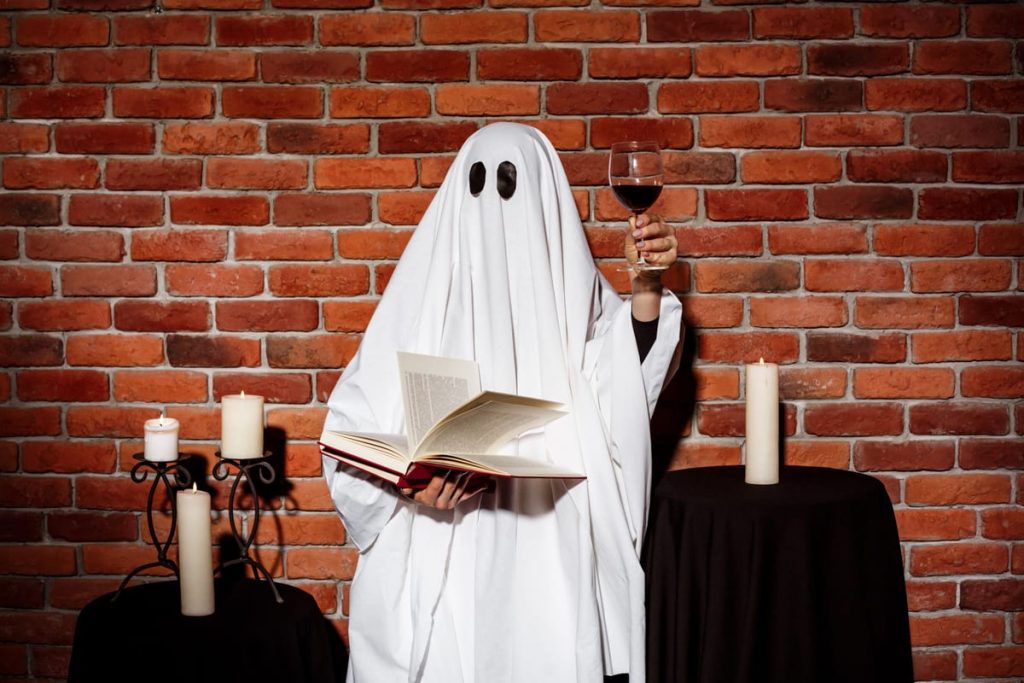
That image is different from the cartoon-style white-sheet ghost common in Western Halloween decorations.
This is why vocabulary cannot always be separated from cultural context.
A dictionary can tell you what a word means. Understanding the folklore behind it tells you why people use that word and what images or emotions it may evoke.
How Do Ghosts Say “Boo” in Different Languages?
“Boo!” is strongly associated with English-speaking Halloween culture.
It is short, surprising, and easy to shout when someone jumps from behind a door. It also appears everywhere from children’s books to decorations and Halloween advertising.
Other languages have their own ways of representing frightening or surprising sounds.
German speakers may encounter Buh! as an equivalent. In Spanish, someone trying to scare another person might shout ¡Bú! French can use Bouh!
Explore our seasonal celebrations across languages for details.
These similarities are not accidental in every case. Languages borrow words and expressions from one another, while global movies, television, tourism, and advertising spread familiar Halloween language across borders.
But the sound a culture associates with frightening someone does not always need a neat translation.
This highlights an interesting linguistic concept: written sound effects are shaped by language.
Think about animal sounds.
English speakers say a dog goes “woof,” while speakers of another language may write the same sound differently. The dog has not changed; the linguistic system used to represent its sound has.
Spooky sounds work in a similar way.
For translators and marketers, that means replacing one word with its dictionary equivalent may not create the same emotional effect.
Ghosts, Witches, and Monsters Change Across Languages
Some supernatural creatures appear in many cultures, but their stories can differ significantly.
English-language Halloween imagery frequently includes ghosts, witches, vampires, werewolves, skeletons, zombies, and black cats. International folklore offers a much wider supernatural cast.
Mexico is famous for stories about La Llorona, the “Weeping Woman,” whose legend has numerous regional versions.
Ireland has the banshee, a supernatural figure traditionally associated with a wailing cry and approaching death. The English word comes from the Irish bean sí, referring to a woman of the fairy mound.
Japanese folklore includes yōkai, a broad category of strange supernatural beings and phenomena. Individual yōkai can range from frightening creatures to mischievous or unusual figures.
Slavic traditions contain their own supernatural beings, while Latin American, African, South Asian, Southeast Asian, and Middle Eastern cultures have extensive bodies of folklore that cannot simply be placed under the Western label “Halloween monsters.”
These differences matter when translating stories or producing multilingual content.
Calling every supernatural figure a “ghost” or “monster” may remove important cultural details. A culturally informed translation needs to consider what the creature represents, where the story originated, and what readers already know about it.
Halloween Traditions Around the World Are Not the Same
Modern Halloween is especially visible in countries influenced by American and British popular culture, but celebrations connected with spirits and the dead vary considerably around the world. Explore our festival words in every language for details.
Halloween itself has historical connections with Samhain, an ancient festival associated with Ireland and other Celtic traditions. Over centuries, religious practices, migration, folklore, and popular culture helped shape the modern holiday.
Mexico’s Día de los Muertos, or Day of the Dead, is sometimes grouped together with Halloween because the dates are close and both may feature skeleton imagery.
They are not interchangeable celebrations.
Día de los Muertos centers on remembrance of deceased family members and loved ones. Traditions can include altars, photographs, marigolds, candles, food, and visits to cemeteries.
In parts of Europe, All Saints’ Day and All Souls’ Day carry religious and family significance.
Elsewhere, communities have entirely different festivals honoring ancestors or addressing ideas about spirits and death.
Even where Halloween has become popular, customs can change locally.
Costume parties may become more prominent than trick-or-treating. Shopping centers may host Halloween events, while restaurants and entertainment venues use the occasion for themed promotions.
The calendar date can travel easily. The cultural meaning does not always travel with it.
Why “Trick-or-Treat” Is Difficult to Translate
“Trick or treat!” may be one of the most recognizable Halloween expressions in English.
It is also an excellent example of why translation requires context.
The phrase works because English-speaking audiences already understand the custom behind it: children in costumes visit homes and request treats, traditionally with a playful suggestion that a “trick” could follow if no treat is provided.
A literal translation can sound strange where that custom is unfamiliar.
Some languages adopt an English expression, develop a local equivalent, or use wording that focuses on asking for sweets.
The translator therefore has several questions to consider.
Who will read the phrase? Do they celebrate Halloween? Are they familiar with trick-or-treating? Is the wording for a children’s event, advertisement, film subtitle, school lesson, or tourism campaign? Explore our cultural context in translation for details.
Context determines whether preserving, adapting, or explaining the expression makes the most sense.
This is one reason professional language services can be useful for culturally specific content. Vanan Services Inc supports multilingual communication where meaning, audience, and cultural context all need consideration rather than simple word replacement.
Halloween Translation Matters for International Marketing
Halloween has become a major seasonal marketing opportunity for businesses in many markets.
Brands use spooky language for emails, advertisements, social media campaigns, product packaging, games, tourism promotions, and retail events.
However, a Halloween slogan that works perfectly in English may fail after literal translation.
Wordplay is particularly challenging.
Phrases such as “fang-tastic,” “spooktacular,” and “witching you a happy Halloween” depend on English pronunciation and double meanings. Their humor can disappear completely in another language.
Images deserve similar attention.
A supernatural character that seems playful in one market may have religious, historical, or frightening associations elsewhere. Symbols associated with death and ancestors may also require more care than ordinary seasonal decorations.
International marketers should therefore consider language and cultural relevance together.
The goal is not necessarily to make every campaign identical. Sometimes adaptation is more effective because it allows the central message, humor, or emotion to feel natural to the intended audience.
Working with experienced linguists can help businesses identify phrases that need additional context or creative adaptation before multilingual content reaches customers.
What Halloween Language Teaches Us About Culture
Halloween vocabulary provides an entertaining doorway into a serious language lesson.
Words do more than label objects.
They carry stories.
When language learners explore words for ghosts, spirits, monsters, death, fear, and celebration, they also encounter mythology, religion, history, humor, and social customs. Explore our professional translation services for details.
Educators can use Halloween vocabulary as an opportunity for cultural comparison rather than simple memorization.
Students might compare ghost stories from two countries, investigate how different languages write frightening sounds, or examine whether a familiar supernatural creature has a close equivalent elsewhere.
The same approach is valuable for professional communication.
Translators and global businesses need to consider whether audiences share the cultural knowledge required to understand a message. When they do not, the language may need explanation or adaptation.
That is what makes Halloween words across languages so fascinating.
A ghost may cross borders.
Its name, appearance, story, and frightening sound can change along the way.
FAQs About Halloween Words Across Languages
Is “Boo” the same in every language?
No. “Boo” is strongly associated with frightening or surprising someone in English, but other languages can represent similar sounds differently. Some have forms that look or sound close to “boo,” while others rely on different expressions. Popular culture has also helped English Halloween vocabulary spread internationally, so English expressions may appear alongside local ones. The best choice depends on the language, region, audience, and situation.
Is Halloween celebrated the same way around the world?
No. Halloween traditions vary by country and community. Trick-or-treating, costume parties, pumpkin carving, haunted attractions, and seasonal decorations may be common in some places but uncommon in others. Some countries also have separate religious or cultural observances connected with ancestors and the dead. These traditions should not automatically be treated as local versions of Halloween because their histories, purposes, and cultural meanings can be very different.
Why are supernatural words difficult to translate?
Supernatural vocabulary is closely connected to folklore. Two words may appear equivalent in a dictionary while describing creatures with different origins, appearances, behaviors, or cultural significance. Translators therefore need to consider the surrounding story and the audience’s knowledge. Depending on the purpose of the text, retaining the original term and briefly explaining it may sometimes preserve more cultural meaning than replacing it with a familiar English supernatural category.
Why should businesses localize Halloween marketing?
Localization helps businesses make seasonal content understandable and culturally appropriate for each audience. Halloween jokes, puns, supernatural characters, and customs often depend heavily on cultural knowledge, so direct translation can weaken humor or create confusing messages. Professional language support can help organizations adapt wording while maintaining the campaign’s intended purpose and tone. Vanan Services Inc can assist businesses handling multilingual content for audiences across different linguistic and cultural markets.
Halloween Words Show Why Language Is More Than Vocabulary
From “boo” and fantasma to yūrei and banshee, supernatural vocabulary shows how closely language is connected with history and culture.
Halloween may have become an internationally recognizable occasion, but people do not necessarily describe ghosts, celebrate the season, or understand spooky folklore in the same way.
For language learners, these differences make vocabulary more memorable. For educators, they create opportunities for cultural discussion. For international organizations, they highlight why multilingual communication requires attention to both words and context.
When your message needs to cross languages and cultures, accurate wording is only part of the job.
Vanan Services Inc helps organizations communicate multilingual content clearly and appropriately for diverse audiences. Explore professional language services to help your next message travel without losing what it was meant to say.